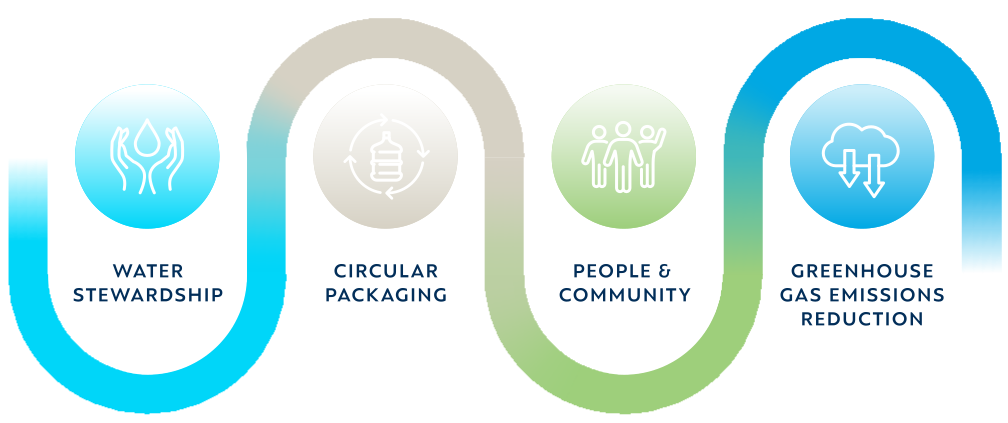
Our mission is to Hydrate a Healthy America™. We are focused on helping to provide quality drinking water responsibly, through water and environmental stewardship, circular packaging including reuse and refill, and investing in our people and the local communities where we live, work and play.
Our Sustainability Goals
Our sustainability goals help us to set our direction and measure progress over the next ten years. For details on our goals, please download our strategy.
2025 Highlights
400MM
gallons of water replenished locally
29.6%
of our volume is sold in reusable formats
$5.23MM
cash contributions and product donations
-8%
reduction in scope 1, 2 and 3 emissions1
Sustainability Report 2025
The second Primo Brands Sustainability Report reviews our 2025 performance and progress against our goals.
We are focused on water stewardship from source to sip. We strive to enhance the responsible management of water resources, work closely with our communities, and help support the availability of quality drinking water for the long term.
We help to conserve over 28,000 acres of land across the U.S. and Canada, and we partner on projects which help to conserve, enhance and restore watersheds.We support local water resiliency through projects thatmaintain and enhance water resources. In our factories, we aim to increase water efficiency and reduce waste.
4 Sites
certified to Water Stewardship and Resiliency (WSR) Standard
23,500+
self-service refill stations
Circular Packaging
We provide healthy hydration in formats that are reusable, refillable and recyclable. We focus on increasing the circularity of our packaging, from the materials we use — including recycled content — to our refill solutions.
We offer the largest self-service water refilland exchange network in the U.S.In addition, we recognize that reliable recycling infrastructure at a municipal level is critical to achieving our goals and making an impact. That’s why we partnerwith suppliers and other third-party organizations to enable innovation at scale and advocate for change both locally and nationally.
People and Community
We focus on creating a safe and healthy workplace where people fulfill their potential and feel safe, respected and valued. The same values extendthroughout our supply chain, and our Supplier Code of Conduct highlights our expectations of our partners.
We invest in our communities to help provide healthy hydration and support local environmental stewardship, including educating the next generation of water stewards.
100%
of associates engaged in a performance review
12MM+
on-road miles reduction
Greenhouse Gas Emissions Reduction
In our own operations, we are focused on increasing energy efficiency in our factories. In the distribution of products through our own fleets, we are reducing miles driven by optimizing and consolidating route networks and payload. We are also transitioning to alternative fuel types, such as propane.
The majority of our Scope 3 emissions come from packaging suppliers and third-party carriers. We are working with both of these groups to help reduce emissions.
Responsible Business
Primo Brands is committed to doing business in compliance with the highest standards of business ethics and in compliance with all applicable laws. Our Code of Business Conduct and Ethics sets expectations for our company’s culture and behavior for proper and ethical business conduct and provides general guidelines for conducting the business of the company.
Our governance structure provides oversight, as well as a framework for managing our sustainability strategy and initiatives.
Primo Brands’ Policy Positions: In 2022, Primo Brands undertook efforts to better understand best-in-class deposit return systems (DRS) in a pursuit of being a transparent and constructive partner in developing future policy. Primo Brands supports a best-in-class DRS policy.
1Scope 1 and 2 market-based emission increased by 4.8% due to reduced renewable energy purchases. Scope 2 location-based emissions reduced by 8.5%. Scope 3 reduced by 10%
In 2023, approximately 23-33% of PET bottles were collected for recycling, the highest level since 1996. Recycling rates of PET vary across regions and recycling programs with bottle deposit return systems achieve substantially higher rates, often exceeding 80%. Mechanical recycling remains the dominant recycling pathway for PET; however mechanical recycling can result in polymer degradation and reduced material performance, prompting ongoing development of technologies aimed at improving recycled material quality.